See exactly what you get
These are complete, real-format samples of what you receive: the English translation with the original layout preserved, the signed Certificate of Translation Accuracy ($25 per page), and the notarized version with the New York notary seal ($35 per page). Updated September 26, 2026.
Every order comes back as one print-ready PDF in three parts: a copy of your original, the English translation laid out to match it, and a signed Certificate of Translation Accuracy, notarized by a separate commissioned New York notary on the $35 tier. Here are two complete specimens.
Uzbek birth certificate → English
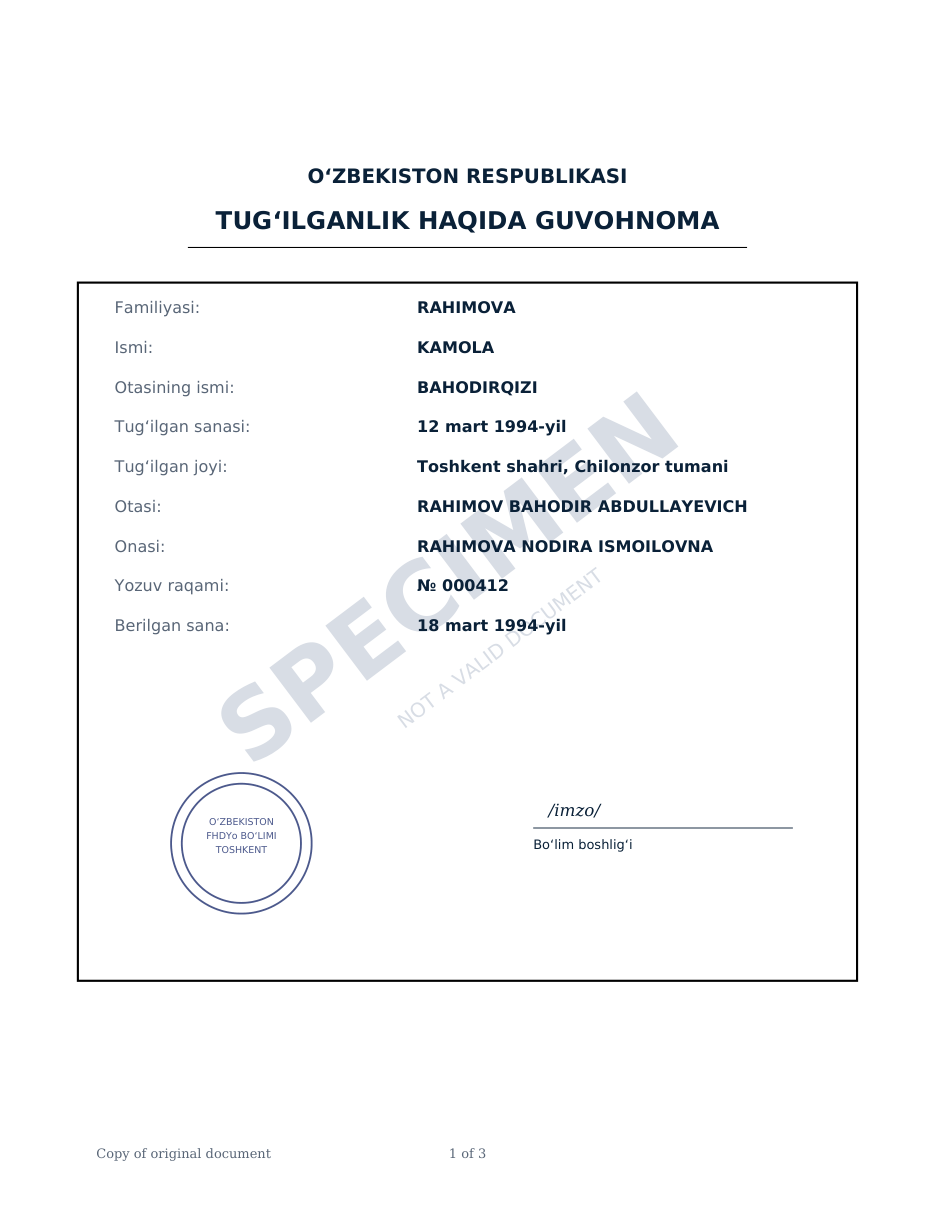
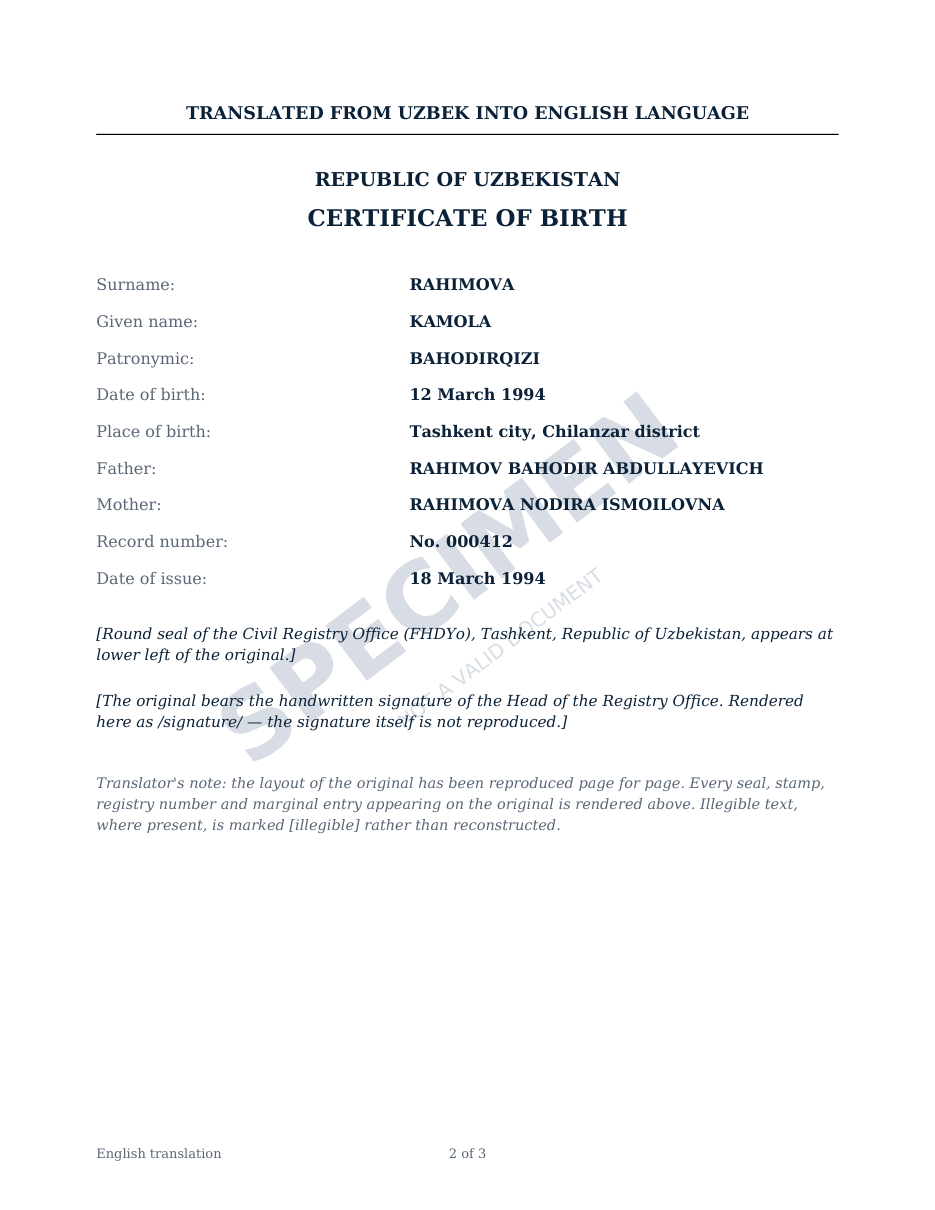
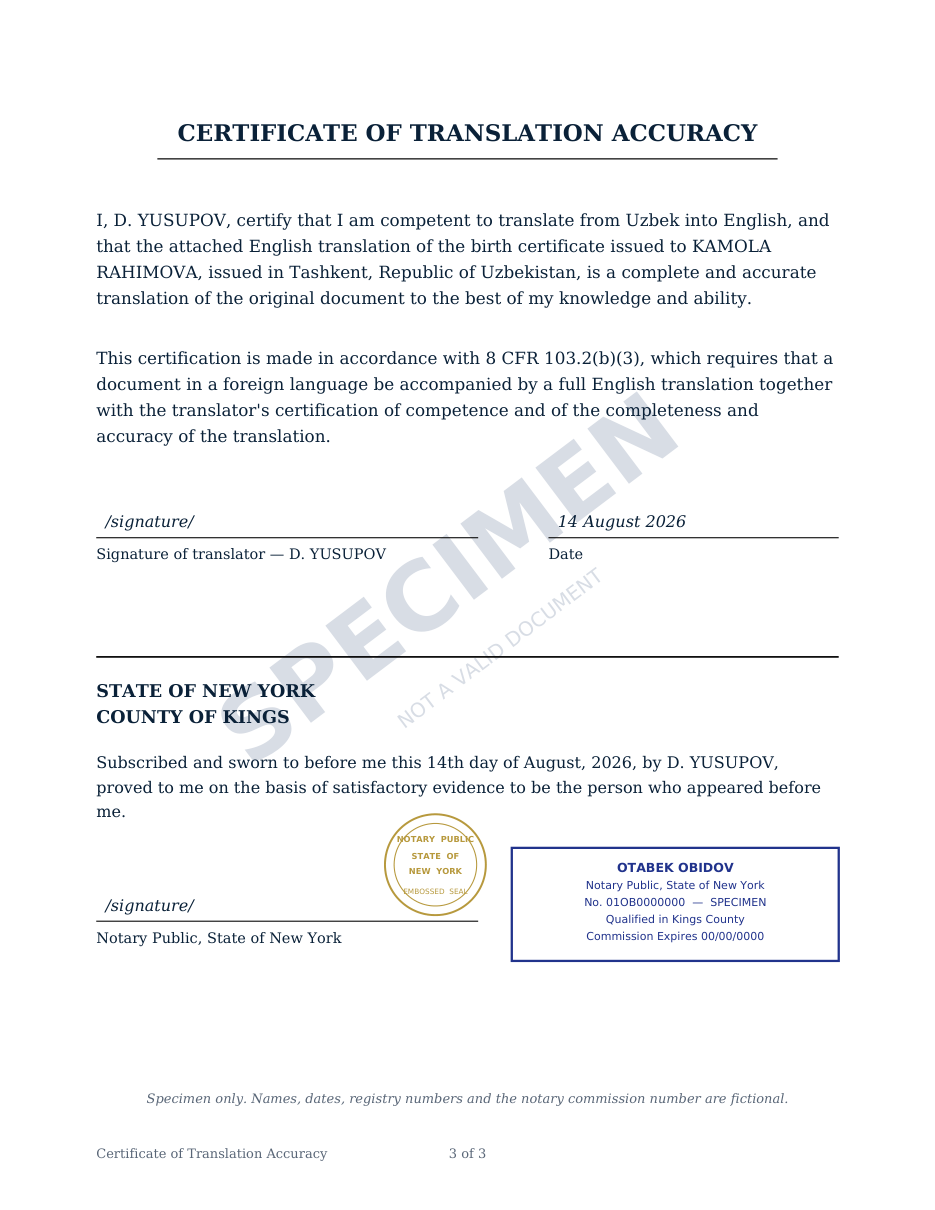
Tashkent civil registry certificate. Every field, the registry number and the office seal are carried across; the signature is rendered /signature/ rather than reproduced.
Soviet-era employment record book (Russian) → English
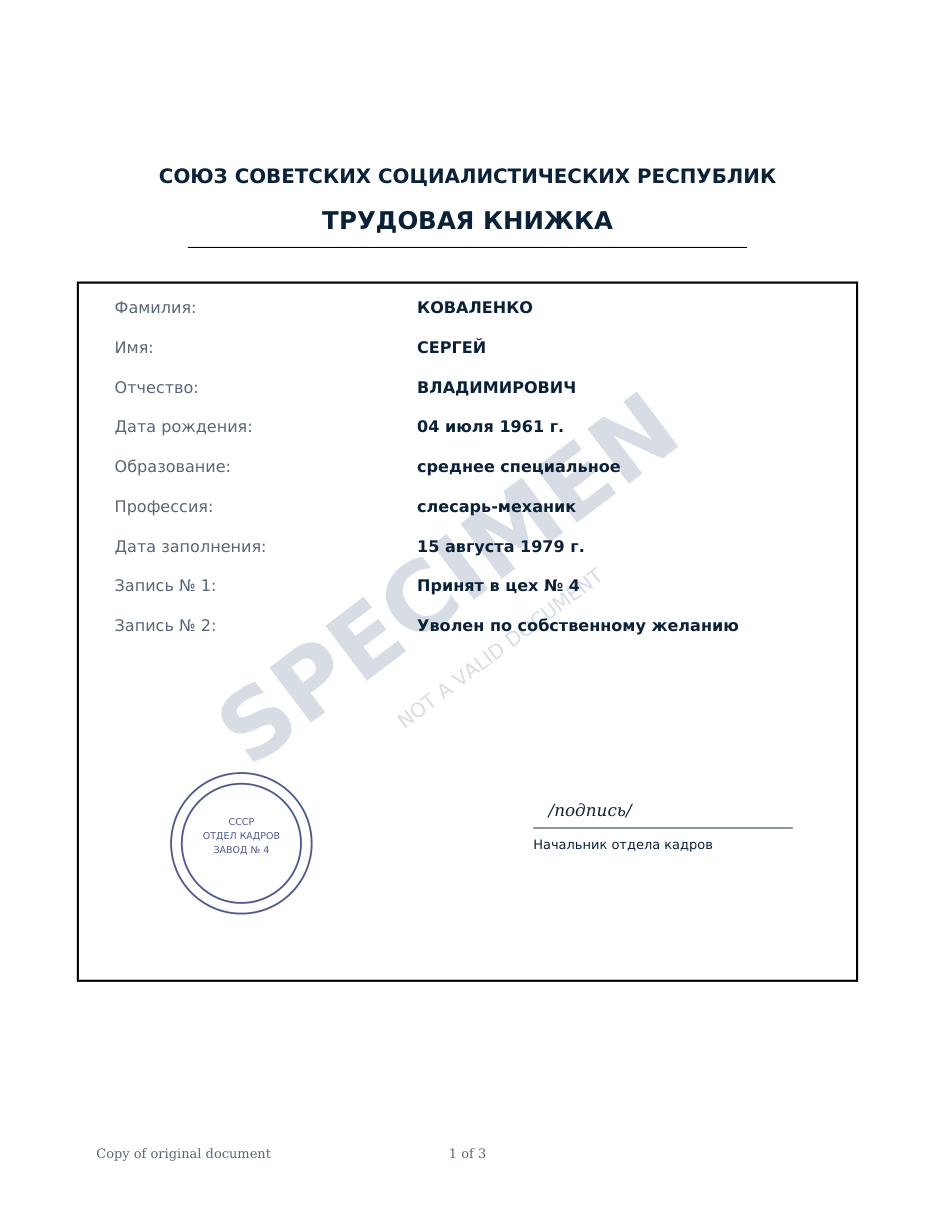
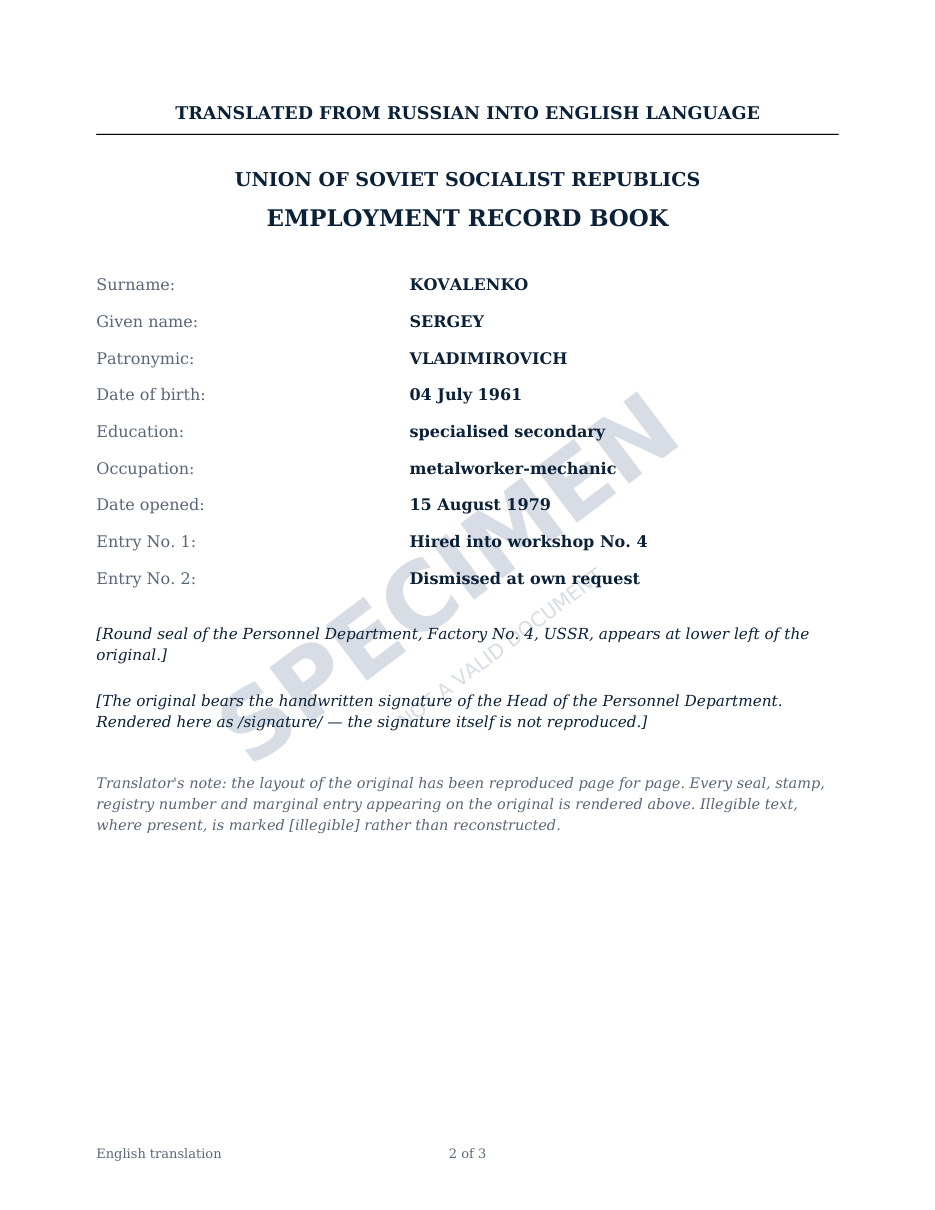
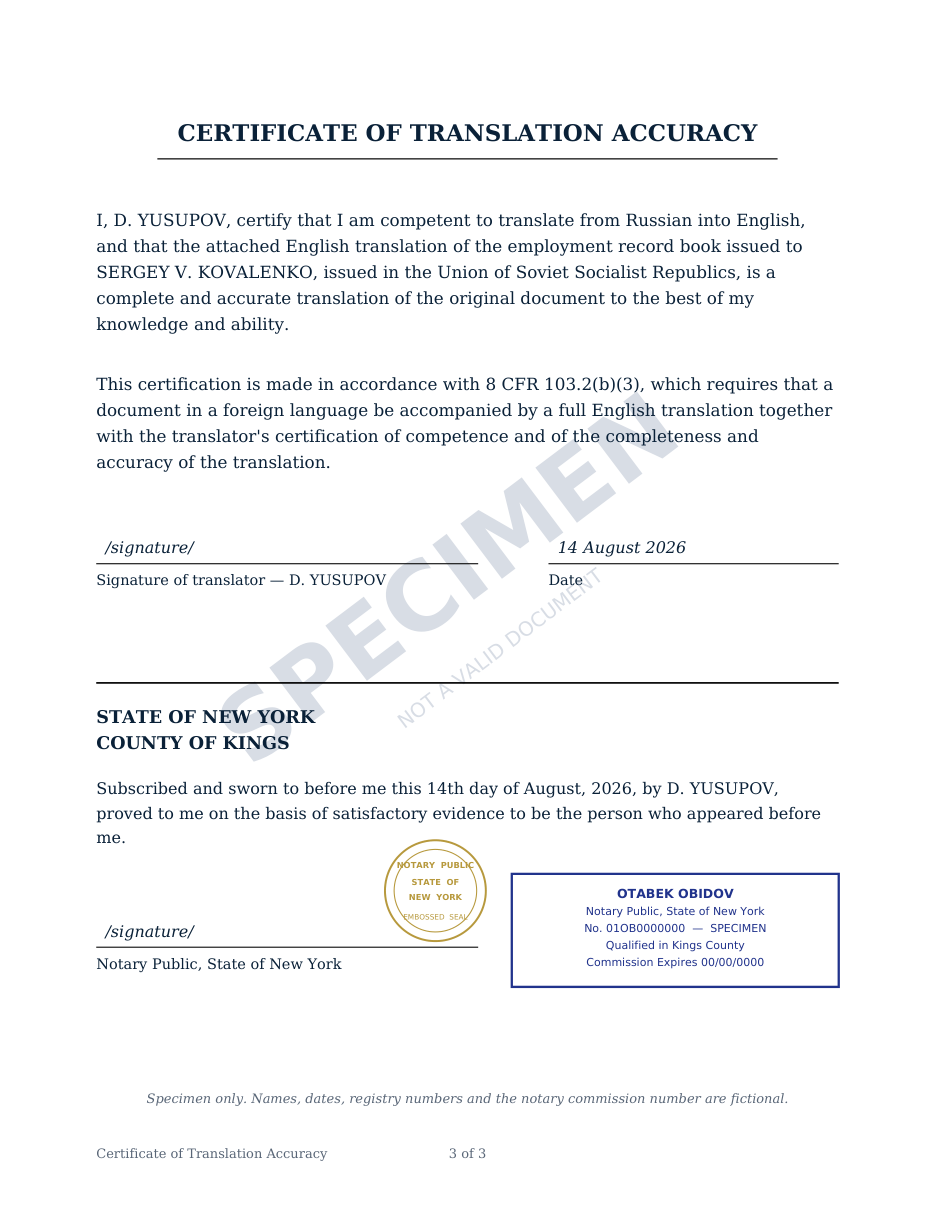
A 1979 trudovaya knizhka. Handwritten entries, the personnel-department seal and the workshop numbers are all translated — incomplete translation is the leading cause of rejection.
These are specimens. The names, dates, registry numbers and the notary commission number are fictional, and every page is watermarked, so nothing here can be mistaken for a filed document. Your real packet carries the actual translator's name and a live notary commission.
What “certified” and “notarized” actually mean
Your translator signs a Certificate of Translation Accuracy stating that the translation is complete and accurate and that they are competent to translate from Uzbek or Russian into English. That certificate is what 8 CFR 103.2(b)(3) requires for USCIS.
A New York notary public then witnesses and notarizes the translator's signature — nothing more. A notary cannot certify that a translation is accurate, and a New York notary cannot issue certified or “true” copies of any document. Anyone offering you a “notarized certified copy” in New York is offering something a notary has no authority to do.
The translator and the notary are always two different people. A notary may not notarize their own signature, or a document in which they have an interest.
USCIS does not require notarization at all. Courts, consulates and institutions abroad frequently do ask for it — that is the $35 notarized tier, where a separate commissioned New York notary notarizes the translator's signature.
What makes it acceptable
- Complete. Every seal, stamp, marginal note and reverse side is translated — not just the fields someone thinks matter.
- Layout preserved. An officer can lay the original beside the translation and match them line for line.
- Signed certification. The translator certifies competence, completeness and accuracy — the three things 8 CFR 103.2(b)(3) actually asks for.
- Notarized when you need it. USCIS does not require it — the certified version is $25 a page. Courts, consulates and schools abroad often do — then it is $35 a page with the New York notary seal.
- Separate hands. The translator signs, and a different person notarizes — a notary may not notarize their own signature.
On paper, if you need it
Hard copies are printed, signed in wet ink and finished with an embossed seal over the notary stamp, then sent USPS tracked for $15. The digital PDF is included either way.
Apostilled packet — for use abroad
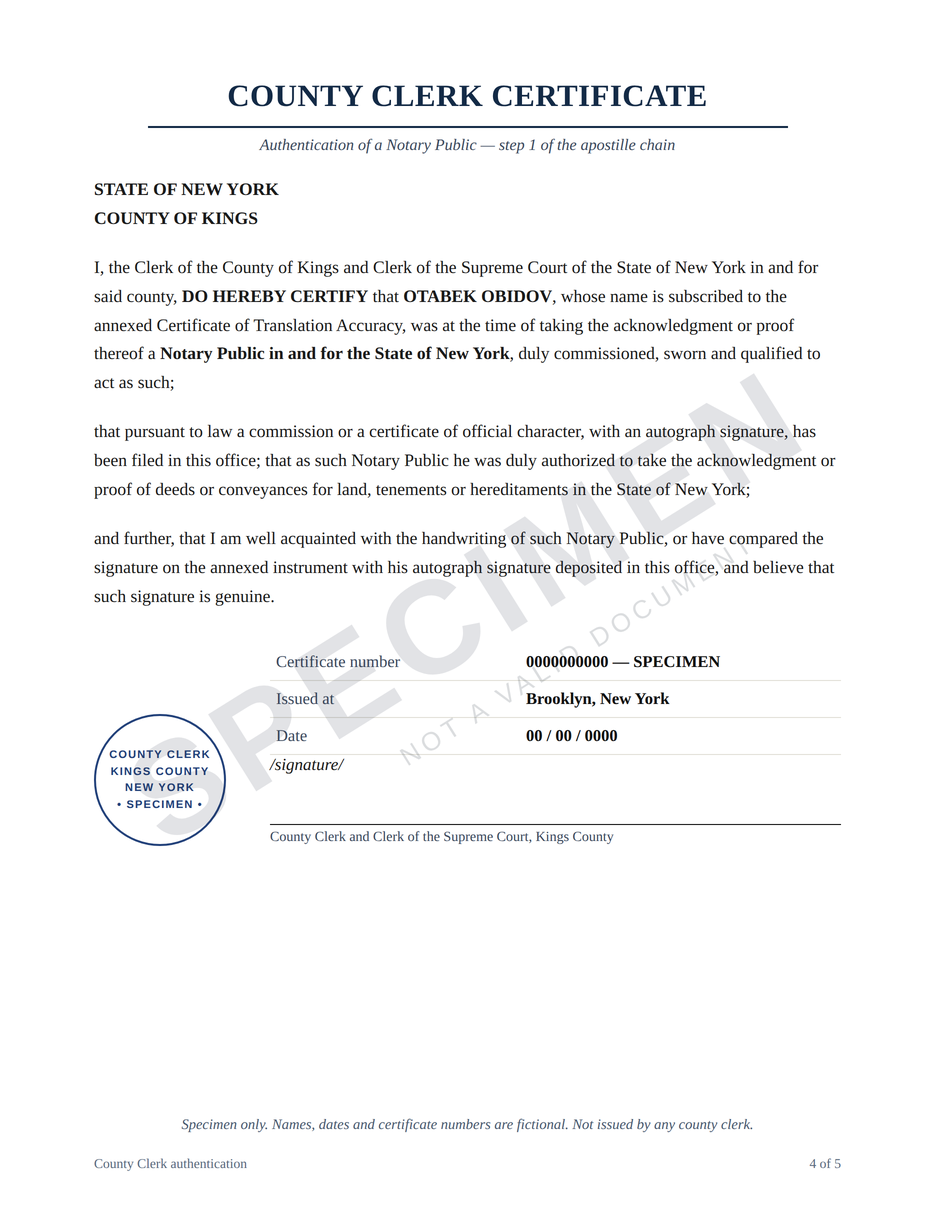
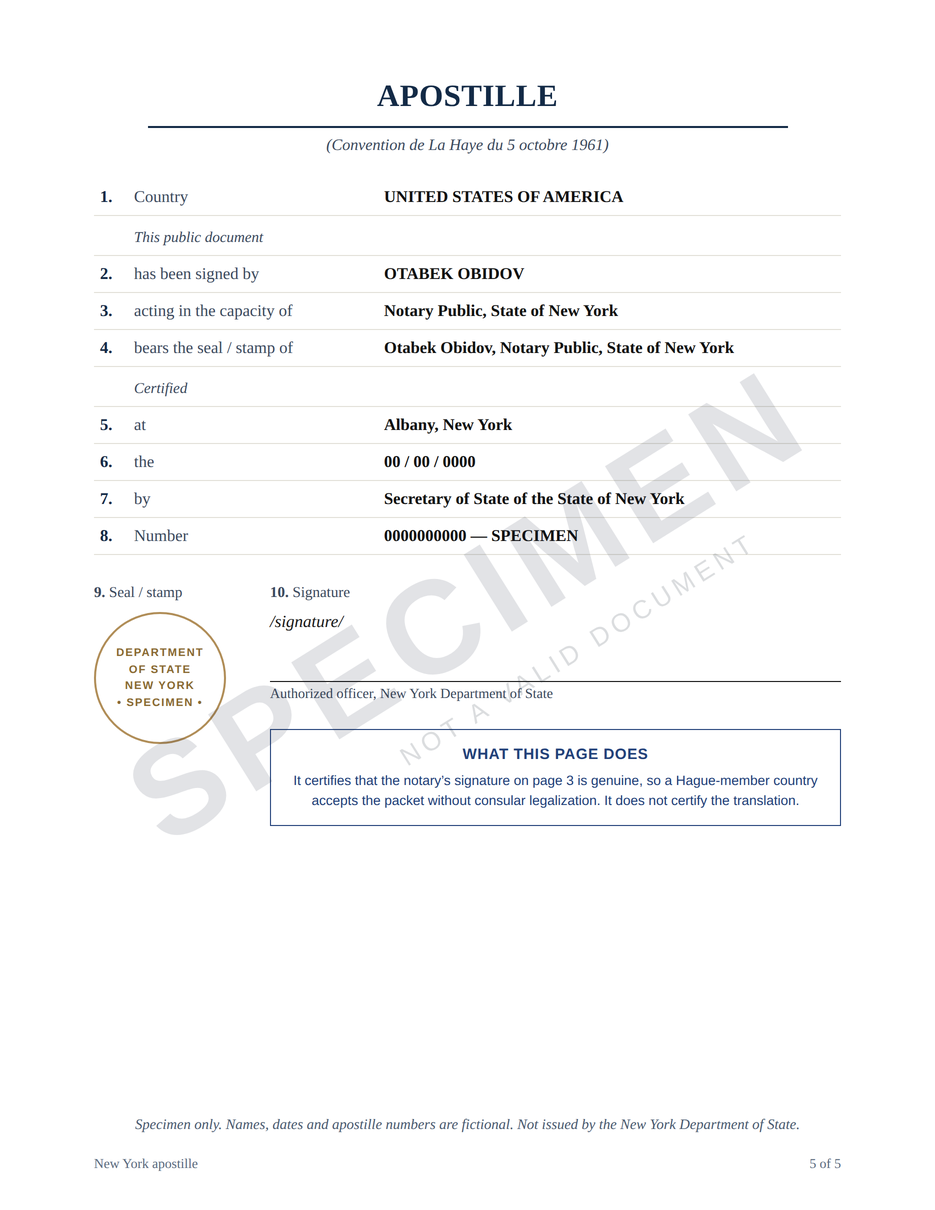
When a document is going to a consulate or a foreign authority, two more pages are added in ink, in person: the County Clerk authenticates the notary, then the New York Department of State issues the apostille. This is why an apostille has to be shipped and cannot be emailed.
Ready to get started?
Upload your document, see the exact price on screen, and pay in the same minute — From $25 a page — $35 with notarization — delivered in 24 hours on orders up to 3 pages. No waiting on a quote.
Upload & Pay — from $25/page